
Mercedes Sedan Model History: The Ultimate Guide
Want to understand the evolution of Mercedes-Benz sedans? This guide offers a concise overview of the Mercedes sedan model history, highlighting key models and their significance. From the iconic predecessors to the modern marvels, discover the legacy of luxury and innovation.
Mercedes-Benz sedans are known for their luxury, performance, and innovation. But with so many models and generations, it can be tough to keep track of their history. This guide simplifies the journey, offering a clear and straightforward overview of the most important Mercedes sedan models. We’ll cover everything from the early classics to the latest releases, making it easy to understand the evolution of these iconic vehicles.
Ready to dive in? We’ll explore each significant model, highlighting their key features and contributions to the Mercedes-Benz legacy. By the end of this article, you’ll have a solid understanding of Mercedes sedan model history, empowering you to appreciate these vehicles even more.
FAQ: Mercedes Sedan Model History
Here are some frequently asked questions about Mercedes-Benz sedan models:
- What was the first Mercedes-Benz sedan?
The Benz Patent-Motorwagen, built in 1886, is considered the first automobile and a predecessor to Mercedes-Benz sedans. - What makes a Mercedes-Benz sedan stand out?
Mercedes-Benz sedans are known for their luxury, advanced technology, performance, and safety features. - What are some popular Mercedes-Benz sedan models?
Popular models include the C-Class, E-Class, and S-Class, each offering different levels of luxury and performance. - How has the design of Mercedes-Benz sedans changed over the years?
The design has evolved from classic, rounded shapes to more aerodynamic and modern designs, incorporating new technologies and materials. - Are Mercedes-Benz sedans reliable?
Mercedes-Benz sedans are generally reliable with proper maintenance, but like all vehicles, they can have specific issues depending on the model and year. Regular servicing is crucial. - What is AMG in the context of Mercedes-Benz sedans?
AMG stands for Aufrecht Melcher Großaspach, the performance division of Mercedes-Benz. AMG models offer enhanced engines, sportier handling, and unique styling. - Where can I find more information about specific Mercedes-Benz sedan models?
You can find detailed information on the Mercedes-Benz official website, automotive news sites, and enthusiast forums.
The Dawn of Mercedes-Benz Sedans

The history of Mercedes-Benz sedans begins with the birth of the automobile itself. Karl Benz’s 1886 Patent-Motorwagen laid the foundation for automotive innovation. While not a sedan in the modern sense, it was the first step toward the luxurious vehicles we know today. Let’s explore these early years:
- 1886: Karl Benz patents the Benz Patent-Motorwagen, considered the first automobile.
- Early 1900s: Daimler-Motoren-Gesellschaft (DMG) produces early Mercedes models, focusing on performance and luxury.
- 1926: Daimler and Benz merge to form Daimler-Benz, creating the Mercedes-Benz brand.
These pioneering efforts set the stage for Mercedes-Benz’s future success. The early models emphasized engineering excellence and a commitment to quality, traits that continue to define the brand.
Key Pre-War Models
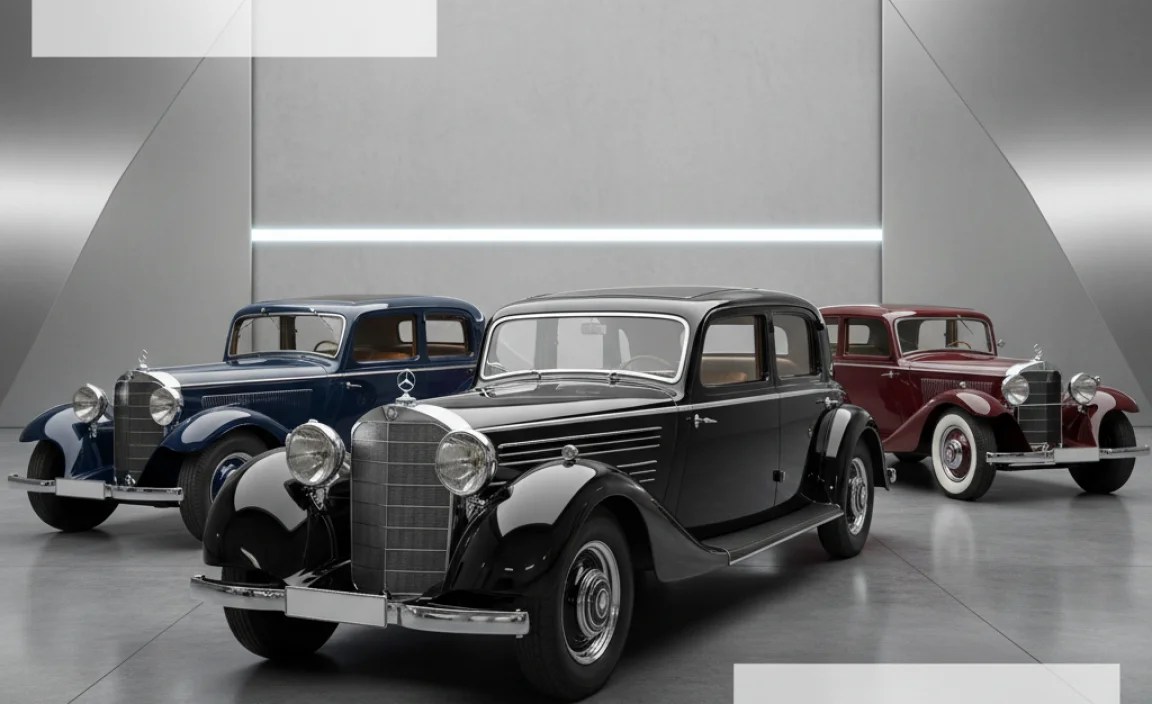
The pre-World War II era saw Mercedes-Benz establishing itself as a leader in automotive engineering and luxury. Several models from this period are particularly noteworthy:
- Mercedes-Benz W03/W04 (1926-1929): The first models to bear the Mercedes-Benz name after the merger.
- Mercedes-Benz W15 (1931-1936): Known for its elegant design and advanced engineering.
- Mercedes-Benz 230 (W143) (1937-1941): Offered comfort and style, appealing to a growing market for luxury vehicles.
These models showcased Mercedes-Benz’s dedication to innovation and luxury. They set the standard for future generations of sedans.
Post-War Recovery and Innovation (1940s-1960s)

Following World War II, Mercedes-Benz focused on rebuilding and innovating. This era saw the introduction of models that would become icons:
- Mercedes-Benz 170 (W136) (1946-1955): One of the first models produced after the war, helping to revive the brand.
- Mercedes-Benz 180 “Ponton” (W120) (1953-1962): Featured a modern, streamlined design and improved comfort.
- Mercedes-Benz 190 (W121) (1956-1961): A more luxurious version of the “Ponton,” offering enhanced features and performance.
The “Ponton” models, in particular, marked a significant step forward in design and engineering. They paved the way for the modern Mercedes-Benz sedan.
The “Fintail” Era (1959-1968)

The “Fintail” or “Heckflosse” models of the late 1950s and 1960s were known for their distinctive tailfins, a nod to American automotive design trends. These models were both stylish and technologically advanced:
- Mercedes-Benz W110 (1961-1968): Known as the “Small Fintail,” it offered a balance of luxury and practicality.
- Mercedes-Benz W111 (1959-1971): The “Large Fintail,” it was larger and more luxurious than the W110.
- Mercedes-Benz W112 (1961-1965): An even more upscale version of the W111, featuring air suspension and other 고급 features.
These models reflected a blend of European luxury and American styling. They were popular among executives and affluent families.
The Birth of the Modern Era (1968-1980s)

The late 1960s and 1970s saw the introduction of models that would define the modern Mercedes-Benz sedan. These cars emphasized safety, engineering, and luxury:
- Mercedes-Benz W114/W115 (1968-1976): Known as the “Stroke-8,” it was a popular and reliable model.
- Mercedes-Benz W116 (1972-1980): The first car officially called the S-Class, it set new standards for luxury and safety.
- Mercedes-Benz W123 (1976-1985): Renowned for its durability and reliability, it became a global success.
The W116 S-Class was a landmark vehicle, introducing features like anti-lock brakes (ABS) and setting the stage for future innovations.
The Compact Executive: The 190 (W201) (1982-1993)
In the early 1980s, Mercedes-Benz introduced a smaller, more affordable sedan to compete with BMW’s 3 Series. The 190 (W201) was a critical success:
- Compact Size: Smaller and lighter than other Mercedes-Benz models, it offered agile handling.
- Advanced Suspension: Featured a multi-link rear suspension for improved ride and handling.
- Popularity: Sold well and helped attract a new generation of buyers to the brand.
The 190 (W201) paved the way for the C-Class, which would become one of Mercedes-Benz’s best-selling models.
The C-Class: A New Generation (1993-Present)
The C-Class replaced the 190 (W201) in 1993 and has since become one of Mercedes-Benz’s most popular models. Each generation has brought new levels of luxury, technology, and performance:
- W202 (1993-2000): The first C-Class, it offered a more modern design and improved performance.
- W203 (2000-2007): Featured a sportier design and advanced technology, including optional navigation and telematics systems.
- W204 (2007-2014): Offered a more refined driving experience and updated styling.
- W205 (2014-2021): Introduced a new level of luxury and technology, with features like a touchpad controller and advanced driver-assistance systems.
- W206 (2021-Present): The latest generation C-Class, it brings a sleek design, electrified powertrains, and cutting-edge technology.
The C-Class continues to be a benchmark in the compact executive sedan segment, combining luxury, performance, and innovation.
The E-Class: Core of the Brand (1993-Present)
The E-Class is considered the heart of the Mercedes-Benz sedan lineup. Known for its balance of luxury, performance, and practicality, the E-Class has a long and storied history:
- W124 (1984-1995): While technically predating the official “E-Class” name, the W124 is considered the predecessor. It was known for its robust engineering and durability.
- W210 (1995-2002): The first official E-Class, it featured a distinctive four-eyed headlight design and a more modern interior.
- W211 (2002-2009): Offered improved performance and technology, including optional air suspension and advanced safety features.
- W212 (2009-2016): Featured a more angular design and a range of efficient engines.
- W213 (2016-2023): Brought a new level of luxury and technology, with features like semi-autonomous driving capabilities.
- W214 (2023-Present): The latest generation E-Class, it combines classic elegance with cutting-edge technology, including advanced driver-assistance systems and a luxurious interior.
The E-Class remains a popular choice for those seeking a luxurious and capable sedan. It perfectly embodies the Mercedes-Benz ethos.
The S-Class: Setting the Standard (1972-Present)
The S-Class is the flagship sedan of Mercedes-Benz, representing the pinnacle of luxury, technology, and innovation. Each generation has set new standards for the automotive industry:
- W116 (1972-1980): The first car officially called the S-Class, it introduced features like anti-lock brakes (ABS).
- W126 (1979-1992): Known for its elegant design and advanced safety features, it was a long-lived and successful model.
- W140 (1991-1998): A controversial design at the time, it was packed with technology and offered a supremely comfortable ride.
- W220 (1998-2005): Featured a more rounded design and advanced electronic systems.
- W221 (2005-2013): Offered a more muscular design and a range of powerful engines.
- W222 (2013-2020): Introduced a new level of luxury and technology, with features like massaging seats and a premium Burmester sound system.
- W223 (2020-Present): The latest generation S-Class, it combines cutting-edge technology with supreme comfort and luxury, setting a new benchmark for the segment.
The S-Class is the ultimate expression of Mercedes-Benz’s commitment to excellence. It continues to be the benchmark for luxury sedans.
The CLS: The Four-Door Coupe (2004-Present)
The CLS-Class is a four-door coupe that combines the sleek styling of a coupe with the practicality of a sedan. It was a groundbreaking model when it was first introduced:
- C219 (2004-2010): The first CLS, it featured a distinctive coupe-like roofline and a luxurious interior.
- C218 (2011-2018): Offered a more aggressive design and improved performance.
- C257 (2018-Present): The latest generation CLS, it combines elegant styling with advanced technology and a refined driving experience.
The CLS-Class appeals to buyers who want a stylish and sporty sedan with a touch of exclusivity.
AMG Models: Performance Redefined
AMG (Aufrecht Melcher Großaspach) is the high-performance division of Mercedes-Benz. AMG models offer enhanced engines, sportier handling, and unique styling. They represent the pinnacle of Mercedes-Benz performance:
- Enhanced Engines: AMG models feature hand-built engines with increased power and torque.
- Sportier Handling: Upgraded suspension, brakes, and steering systems provide улучшен handling and responsiveness.
- Unique Styling: AMG models feature distinctive exterior and interior styling cues, including unique wheels, body kits, and спортивные seats.
AMG models are available for the C-Class, E-Class, S-Class, and CLS-Class, offering a range of performance options for discerning drivers.
Mercedes-Benz Sedan Model History Table
Here is a table summarizing the Mercedes-Benz sedan model history:
| Model | Generation | Years | Key Features |
|---|---|---|---|
| Benz Patent-Motorwagen | N/A | 1886 | First automobile |
| 170 (W136) | N/A | 1946-1955 | Post-war recovery model |
| 180 “Ponton” (W120) | N/A | 1953-1962 | Modern, streamlined design |
| 190 (W121) | N/A | 1956-1961 | Luxurious “Ponton” variant |
| W111 “Fintail” | N/A | 1959-1971 | Distinctive tailfins |
| W114/W115 “Stroke-8” | N/A | 1968-1976 | Popular and reliable |
| S-Class W116 | 1st | 1972-1980 | First official S-Class, ABS |
| S-Class W126 | 2nd | 1979-1992 | Elegant design, advanced safety |
| 190 (W201) | N/A | 1982-1993 | Compact executive sedan |
| E-Class W124 | N/A | 1984-1995 | Robust engineering, durable |
| S-Class W140 | 3rd | 1991-1998 | Technologically advanced, comfortable |
| C-Class W202 | 1st | 1993-2000 | Modern design, improved performance |
| E-Class W210 | 1st | 1995-2002 | Four-eyed headlight design |
| S-Class W220 | 4th | 1998-2005 | Rounded design, advanced electronics |
| C-Class W203 | 2nd | 2000-2007 | Sportier design, advanced technology |
| E-Class W211 | 2nd | 2002-2009 | Improved performance, air suspension |
| CLS-Class C219 | 1st | 2004-2010 | Four-door coupe |
| S-Class W221 | 5th | 2005-2013 | Muscular design, powerful engines |
| C-Class W204 | 3rd | 2007-2014 | Refined driving experience |
| E-Class W212 | 3rd | 2009-2016 | Angular design, efficient engines |
| CLS-Class C218 | 2nd | 2011-2018 | Aggressive design, improved performance |
| S-Class W222 | 6th | 2013-2020 | Luxury, massaging seats |
| C-Class W205 | 4th | 2014-2021 | Luxury, touchpad controller |
| E-Class W213 | 4th | 2016-2023 | Semi-autonomous driving |
| CLS-Class C257 | 3rd | 2018-Present | Elegant styling, advanced technology |
| S-Class W223 | 7th | 2020-Present | Cutting-edge technology, supreme comfort |
| C-Class W206 | 5th | 2021-Present | Sleek design, electrified powertrains |
| E-Class W214 | 5th | 2023-Present | Classic elegance, advanced driver-assistance systems |
Modern Innovations and Technologies
Mercedes-Benz sedans have consistently led the way in automotive innovation. Here are some of the modern technologies found in recent models:
- MBUX (Mercedes-Benz User Experience): An intuitive infotainment system with voice control and artificial intelligence.
- Advanced Driver-Assistance Systems (ADAS): Features like adaptive cruise control, lane-keeping assist, and automatic emergency braking enhance safety and convenience.
- Electrification: Hybrid and electric powertrains offer improved fuel efficiency and reduced emissions.
- Digital Light: Advanced headlights that can project patterns onto the road to enhance visibility and safety.
- Air Suspension: Provides a smooth and comfortable ride, adapting to different driving conditions.
These technologies demonstrate Mercedes-Benz’s commitment to pushing the boundaries of automotive engineering.
The Future of Mercedes-Benz Sedans
The future of Mercedes-Benz sedans looks bright, with a focus on electrification, sustainability, and advanced technology. The company is investing heavily in electric vehicles and plans to offer electric versions of all its models. Additionally, Mercedes-Benz is exploring new materials and manufacturing processes to reduce its environmental impact.
Here are some trends shaping the future of Mercedes-Benz sedans:
- Increased Electrification: More hybrid and fully electric models will be introduced.
- Advanced Connectivity: Seamless integration of digital services and connectivity features.
- Autonomous Driving: Continued development of self-driving technology.
- Sustainable Materials: Use of recycled and renewable materials in vehicle construction.
- Personalization: Increased customization options to meet individual customer preferences.
Mercedes-Benz is committed to remaining at the forefront of the automotive industry, delivering innovative and sustainable luxury vehicles for generations to come. For more information on Mercedes-Benz and their commitment to safety, you can visit the Insurance Institute for Highway Safety: IIHS Mercedes-Benz Ratings.
Conclusion
From the pioneering Benz Patent-Motorwagen to the cutting-edge S-Class, the Mercedes-Benz sedan model history is a testament to innovation, luxury, and engineering excellence. Each generation has built upon the legacy of its predecessors, setting new standards for the automotive industry. Whether you’re a long-time enthusiast or a new admirer, understanding the history of Mercedes-Benz sedans provides a deeper appreciation for these iconic vehicles. As Mercedes-Benz continues to push the boundaries of technology and design, the future of its sedans promises to be just as exciting as its past.
“`


