
Mercedes Twin Turbo Models: Your Complete Guide
Mercedes-Benz twin-turbo engines deliver impressive power and efficiency. This guide covers the popular Mercedes twin-turbo models, including engine specs, performance features, and essential maintenance tips. Learn how to maximize your driving experience and keep your Mercedes running smoothly.
Have you ever wondered what makes some Mercedes-Benz models so incredibly powerful and responsive? The answer often lies in their advanced twin-turbo engine technology. These engines offer a fantastic blend of performance and efficiency, but understanding the specifics can be a bit overwhelming. Many owners find it challenging to keep track of different engine types, performance figures, and maintenance requirements.
This comprehensive guide will walk you through everything you need to know about Mercedes twin-turbo models. We’ll cover the most popular engines, their key features, performance specs, and essential maintenance tips. By the end, you’ll have a clear understanding of what makes these engines special and how to keep your Mercedes running at its best. Let’s dive in!
Understanding Mercedes Twin-Turbo Technology

Mercedes-Benz has long been at the forefront of automotive engineering, and their twin-turbo engines are a prime example of their innovation. Let’s break down the basics of this technology.
What is a Turbocharger?
A turbocharger is a forced induction device that increases an engine’s power output by forcing more air into the combustion chamber. More air means more fuel can be burned, resulting in a bigger explosion and more power.
How Does a Twin-Turbo System Work?
In a twin-turbo system, two turbochargers are used instead of one. There are two main types of twin-turbo setups:
- Parallel Twin-Turbo: Each turbocharger is fed by half of the engine’s cylinders. This setup is common in V-shaped engines.
- Sequential Twin-Turbo: One turbocharger operates at low engine speeds for quick response, while the second turbocharger kicks in at higher speeds for maximum power.
Benefits of Twin-Turbo Engines
Twin-turbo engines offer several advantages over single-turbo or naturally aspirated engines:
- Reduced Turbo Lag: Smaller turbochargers spool up faster, reducing the delay between pressing the accelerator and feeling the power.
- Increased Power: More air forced into the engine results in higher horsepower and torque.
- Improved Efficiency: Twin-turbo engines can be tuned for better fuel economy while still delivering impressive performance.
Popular Mercedes Twin-Turbo Models

Mercedes-Benz offers a wide range of models equipped with twin-turbo engines. Here are some of the most popular:
C-Class
The C-Class is a popular entry-level luxury car that offers several twin-turbo options.
- C300: Equipped with a 2.0L inline-4 turbo engine, often paired with a mild-hybrid system for enhanced efficiency.
- AMG C43: Features a more powerful twin-turbo V6 engine, delivering sporty performance and enhanced driving dynamics.
- AMG C63: (Previous Generations) Used to feature a handcrafted 4.0L twin-turbo V8 engine for exceptional power and acceleration.
E-Class
The E-Class is known for its blend of luxury and performance, with several twin-turbo engine options available.
- E450: Powered by a 3.0L inline-6 turbo engine with mild-hybrid technology, offering a smooth and responsive driving experience.
- AMG E53: Features an enhanced version of the inline-6 turbo engine, delivering increased power and sporty handling.
- AMG E63: Boasts a handcrafted 4.0L twin-turbo V8 engine, providing exhilarating performance and track-ready capabilities.
S-Class
The S-Class represents the pinnacle of luxury and innovation, with powerful twin-turbo engines to match.
- S500/S580: Equipped with a 3.0L inline-6 or 4.0L V8 twin-turbo engine, both featuring mild-hybrid systems for enhanced efficiency and performance.
- AMG S63: Features a handcrafted 4.0L twin-turbo V8 engine, delivering unmatched power and luxury.
AMG GT
The AMG GT is a high-performance sports car that showcases the best of Mercedes-AMG engineering.
- AMG GT: Powered by a handcrafted 4.0L twin-turbo V8 engine, offering incredible power and track-focused performance.
- AMG GT 63 S: A more potent version of the 4.0L twin-turbo V8, delivering even more horsepower and torque for blistering acceleration.
GLC and GLE SUVs
These SUVs combine practicality with performance, offering twin-turbo engines for a dynamic driving experience.
- GLC 43/GLE 43: Feature a twin-turbo V6 engine, providing a balance of power and efficiency for everyday driving.
- GLC 63/GLE 63: Equipped with a handcrafted 4.0L twin-turbo V8 engine, delivering impressive acceleration and sporty handling.
Key Engine Specs and Performance
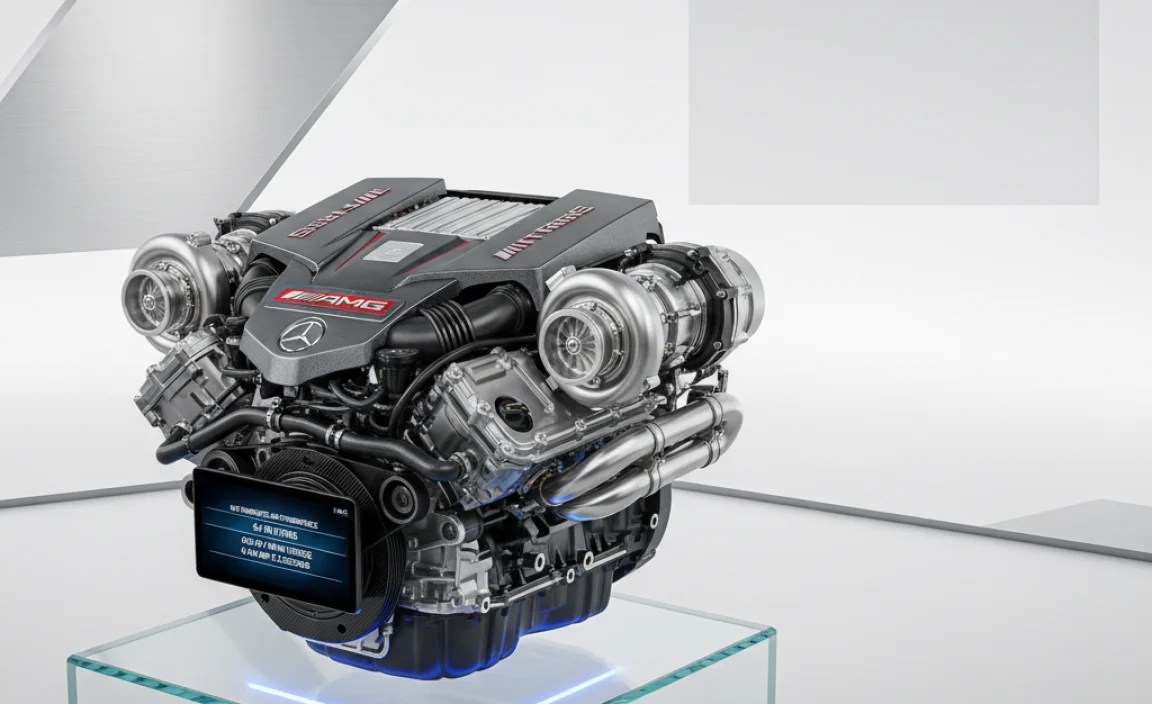
Let’s take a closer look at the specifications and performance figures of some popular Mercedes twin-turbo engines.
2.0L Inline-4 Turbo (M260/M264)
This engine is commonly found in the C300 and other entry-level models.
| Specification | Value |
|---|---|
| Displacement | 2.0L |
| Horsepower | 255-275 hp |
| Torque | 273-295 lb-ft |
| Turbo Configuration | Single Turbo (often with electric auxiliary compressor) |
| Key Features | Direct injection, variable valve timing, mild-hybrid assist |
3.0L Inline-6 Turbo (M256)
This engine powers the E450, S500, and AMG 53 series models.
| Specification | Value |
|---|---|
| Displacement | 3.0L |
| Horsepower | 362-429 hp |
| Torque | 369-384 lb-ft |
| Turbo Configuration | Single Turbo with Electric Auxiliary Compressor |
| Key Features | 48V mild-hybrid system, electric auxiliary compressor, direct injection |
4.0L Twin-Turbo V8 (M177/M178)
This handcrafted engine is the heart of many AMG models, including the C63, E63, S63, and AMG GT.
| Specification | Value |
|---|---|
| Displacement | 4.0L |
| Horsepower | 469-630 hp |
| Torque | 479-664 lb-ft |
| Turbo Configuration | Hot-V Twin-Turbo |
| Key Features | Direct injection, cylinder deactivation (on some models), handcrafted assembly |
Essential Maintenance Tips for Twin-Turbo Engines

To keep your Mercedes twin-turbo engine running smoothly and reliably, follow these essential maintenance tips:
Regular Oil Changes
Oil is the lifeblood of your engine. Regular oil changes are crucial for lubricating the engine’s components and preventing wear. Use the recommended oil type and change it according to the manufacturer’s schedule. Refer to your owner’s manual or a trusted mechanic like those at Mercedes-Benz of Sugar Land for specific guidance.
Air Filter Replacement
A clean air filter ensures that your engine receives the proper amount of air for combustion. Replace the air filter regularly to maintain optimal performance and fuel efficiency.
Spark Plug Inspection and Replacement
Spark plugs ignite the air-fuel mixture in the engine. Over time, they can wear out and cause misfires or reduced performance. Inspect and replace spark plugs according to the manufacturer’s recommendations.
Check and Replace Fluids
Keep an eye on all fluid levels, including coolant, brake fluid, and power steering fluid. Top up or replace fluids as needed to ensure proper system operation.
Inspect Hoses and Belts
Hoses and belts can deteriorate over time, leading to leaks or failures. Regularly inspect them for cracks, wear, or damage, and replace them as needed.
Turbocharger Maintenance
While turbochargers are generally reliable, they can be susceptible to wear and damage. Listen for unusual noises, such as whining or whistling, which could indicate a problem. Regular inspections and proper lubrication can help prolong the life of your turbochargers.
Use High-Quality Fuel
Using high-quality fuel with the recommended octane rating can help prevent engine knocking and ensure optimal performance. Avoid using low-quality or contaminated fuel, which can damage your engine.
Avoid Aggressive Driving When Cold
When the engine is cold, the oil is thicker and doesn’t lubricate as effectively. Avoid aggressive driving until the engine has warmed up to operating temperature. This can help reduce wear and prolong the life of your engine.
Common Issues and Troubleshooting

Even with proper maintenance, twin-turbo engines can experience issues. Here are some common problems and how to troubleshoot them:
Turbo Lag
Symptom: Delay between pressing the accelerator and feeling the power.
Possible Causes: Turbocharger inefficiency, vacuum leaks, faulty sensors.
Troubleshooting: Check vacuum lines, inspect turbocharger components, consult a mechanic.
Loss of Power
Symptom: Reduced engine power or acceleration.
Possible Causes: Boost leaks, faulty diverter valve, clogged air filter.
Troubleshooting: Check air filter, inspect hoses and clamps, test diverter valve.
Unusual Noises
Symptom: Whining, whistling, or grinding noises from the engine.
Possible Causes: Turbocharger damage, bearing failure, exhaust leaks.
Troubleshooting: Inspect turbocharger for damage, check exhaust system for leaks, consult a mechanic.
Check Engine Light
Symptom: The check engine light illuminates on the dashboard.
Possible Causes: Various engine-related issues, including turbocharger problems, sensor failures, or emissions issues.
Troubleshooting: Use an OBD-II scanner to read the error codes, consult a mechanic for diagnosis and repair.
Performance Upgrades for Mercedes Twin-Turbo Engines
If you’re looking to enhance the performance of your Mercedes twin-turbo engine, several upgrades are available. However, it’s essential to choose upgrades carefully and consult with a professional to ensure compatibility and reliability.
ECU Tuning
ECU (Engine Control Unit) tuning involves modifying the engine’s software to optimize performance parameters, such as fuel delivery, ignition timing, and boost pressure. A professional tuner can safely increase horsepower and torque while maintaining reliability.
Exhaust System Upgrades
Upgrading the exhaust system can improve exhaust flow, reduce backpressure, and increase horsepower. Options include cat-back systems, downpipes, and high-flow catalytic converters.
Intake System Upgrades
Upgrading the intake system can improve airflow to the engine, resulting in increased power and throttle response. Options include cold air intakes, performance air filters, and upgraded intake manifolds.
Turbocharger Upgrades
For more significant power gains, you can upgrade the turbochargers themselves. Larger turbochargers can flow more air, resulting in higher horsepower and torque. However, turbocharger upgrades often require additional modifications, such as fuel system upgrades and ECU tuning.
Intercooler Upgrades
An intercooler cools the compressed air from the turbocharger before it enters the engine. Upgrading the intercooler can improve cooling efficiency, reduce intake temperatures, and increase power.
DIY vs. Professional Maintenance
Deciding whether to perform maintenance tasks yourself or hire a professional depends on your skills, experience, and the complexity of the job.
DIY Maintenance
Pros:
- Cost savings
- Convenience
- Personal satisfaction
Cons:
- Requires technical skills and knowledge
- Potential for mistakes
- May void warranty
Professional Maintenance
Pros:
- Expertise and experience
- Proper tools and equipment
- Warranty protection
Cons:
- Higher cost
- Inconvenience
- Dependence on others
For basic maintenance tasks like oil changes and air filter replacements, DIY can be a good option if you have the skills and tools. However, for more complex tasks like turbocharger repairs or ECU tuning, it’s best to consult with a qualified mechanic.
Conclusion
Mercedes-Benz twin-turbo engines offer an impressive combination of performance, efficiency, and luxury. Understanding the technology behind these engines, along with proper maintenance practices, can help you maximize your driving experience and keep your Mercedes running at its best. Whether you’re performing routine maintenance or considering performance upgrades, remember to prioritize quality, reliability, and safety. With the right care and attention, your Mercedes twin-turbo engine will provide years of exhilarating performance.
FAQ: Mercedes Twin Turbo Models
Here are some frequently asked questions about Mercedes twin-turbo models:
What is a twin-turbo engine?
A twin-turbo engine uses two turbochargers to compress air entering the engine, boosting power and efficiency.
Which Mercedes models have twin-turbo engines?
Many Mercedes models feature twin-turbo engines, including various C-Class, E-Class, S-Class, and AMG variants.
How do I maintain a twin-turbo engine?
Regular oil changes, air filter replacements, and spark plug inspections are crucial for maintaining a twin-turbo engine.
What are the benefits of a twin-turbo engine?
Twin-turbo engines offer improved horsepower, torque, and fuel efficiency compared to naturally aspirated engines.
Can I modify my Mercedes twin-turbo engine for more power?
Yes, but modifications should be done by professionals to ensure reliability and avoid damage.
How long do twin-turbo engines last?
With proper maintenance, a Mercedes twin-turbo engine can last well over 150,000 miles.
Are twin-turbo engines reliable?
Yes, Mercedes twin-turbo engines are generally reliable when properly maintained.


