
Mercedes Sedan Tax in Europe: Your Effortless Guide
Navigating taxes on your Mercedes sedan in Europe can feel overwhelming. But don’t worry! This guide simplifies everything. We’ll break down the different taxes, how they’re calculated, and ways to potentially reduce your tax burden. Owning a Mercedes in Europe should be a joy, not a financial headache.
Buying a Mercedes-Benz sedan in Europe is a dream for many. The smooth ride, luxurious interior, and powerful engine are all part of the appeal. However, understanding the tax implications can be confusing. Different countries have different rules, and it’s easy to get lost in the details. This guide will walk you through the common taxes associated with owning a Mercedes sedan in Europe, helping you make informed decisions and avoid surprises.
We’ll cover everything from initial purchase taxes to annual ownership taxes, and even explore potential tax benefits or incentives. By the end of this article, you’ll have a clear understanding of what to expect and how to budget accordingly. Let’s dive in and make the process easier!
Understanding Taxes on Your Mercedes Sedan in Europe

The taxes associated with owning a Mercedes-Benz sedan in Europe vary significantly depending on the country. These taxes can be broadly categorized into purchase taxes and ownership taxes.
Purchase Taxes
Purchase taxes are levied when you initially buy the car. These can include Value Added Tax (VAT), registration tax, and other one-time fees.
- Value Added Tax (VAT): This is a consumption tax applied to the purchase price of the vehicle. VAT rates vary across European countries, typically ranging from 17% to 27%.
- Registration Tax: Many countries impose a registration tax based on factors like engine size, power output (horsepower), and CO2 emissions.
- Other Fees: These might include administrative fees for processing paperwork and issuing license plates.
Ownership Taxes
Ownership taxes are recurring taxes you pay annually or semi-annually. These usually include road tax and potentially other environmental taxes.
- Road Tax: This is an annual tax levied to maintain roads and infrastructure. It’s often calculated based on engine size, CO2 emissions, or vehicle weight.
- Environmental Taxes: Some countries impose additional taxes based on the vehicle’s environmental impact, such as its CO2 emissions or fuel efficiency.
Detailed Breakdown of Tax Types

Let’s delve deeper into each tax type to give you a clearer understanding of how they work and how they’re calculated.
Value Added Tax (VAT)
VAT is a consumption tax added to the price of goods and services. It’s a percentage of the final sale price. Here’s a table showing VAT rates in some European countries:
| Country | Standard VAT Rate |
|---|---|
| Hungary | 27% |
| Sweden | 25% |
| Denmark | 25% |
| Finland | 24% |
| Poland | 23% |
| Italy | 22% |
| Spain | 21% |
| Germany | 19% |
| Luxembourg | 17% |
Example: If you buy a Mercedes sedan for €50,000 in Germany (VAT rate of 19%), the VAT amount would be €50,000 * 0.19 = €9,500. The total price you pay is €59,500.
Registration Tax
Registration tax is a one-time tax paid when you register your vehicle. The calculation method varies widely by country. Some common factors include:
- Engine Size: Larger engines often attract higher taxes.
- Power Output (Horsepower): More powerful engines can result in higher taxes.
- CO2 Emissions: Vehicles with higher CO2 emissions are often taxed more heavily. Many countries are now using CO2 emissions as a primary factor to encourage the purchase of environmentally friendly vehicles.
- Vehicle Price: Some countries base the registration tax on a percentage of the vehicle’s value.
Example: In Denmark, the registration tax is notoriously high and is calculated based on the vehicle’s value. It can significantly increase the overall cost of owning a car.
Road Tax
Road tax, also known as vehicle tax or circulation tax, is an annual tax used to fund road maintenance and infrastructure. Here are some common methods for calculating road tax:
- Engine Size: Some countries still use engine size as a primary factor.
- CO2 Emissions: Many countries are shifting towards using CO2 emissions to encourage lower-emission vehicles.
- Vehicle Weight: Heavier vehicles may be subject to higher taxes due to their increased impact on road wear.
- Vehicle Type: Commercial vehicles often have different road tax rates compared to passenger cars.
Example: In the UK, road tax (Vehicle Excise Duty – VED) is primarily based on CO2 emissions. Vehicles with zero emissions (electric vehicles) are currently exempt from road tax.
Environmental Taxes
Some countries impose additional environmental taxes to discourage the use of polluting vehicles. These taxes can be based on:
- CO2 Emissions: Higher emissions lead to higher taxes.
- Nitrogen Oxide (NOx) Emissions: Some countries are starting to tax vehicles based on their NOx emissions.
- Fuel Efficiency: Less fuel-efficient vehicles may be subject to higher taxes.
Example: In some German cities, there are low-emission zones (Umweltzonen) where only vehicles meeting certain emission standards are allowed. Vehicles that don’t meet these standards may need to pay a fee or face fines.
Country-Specific Examples
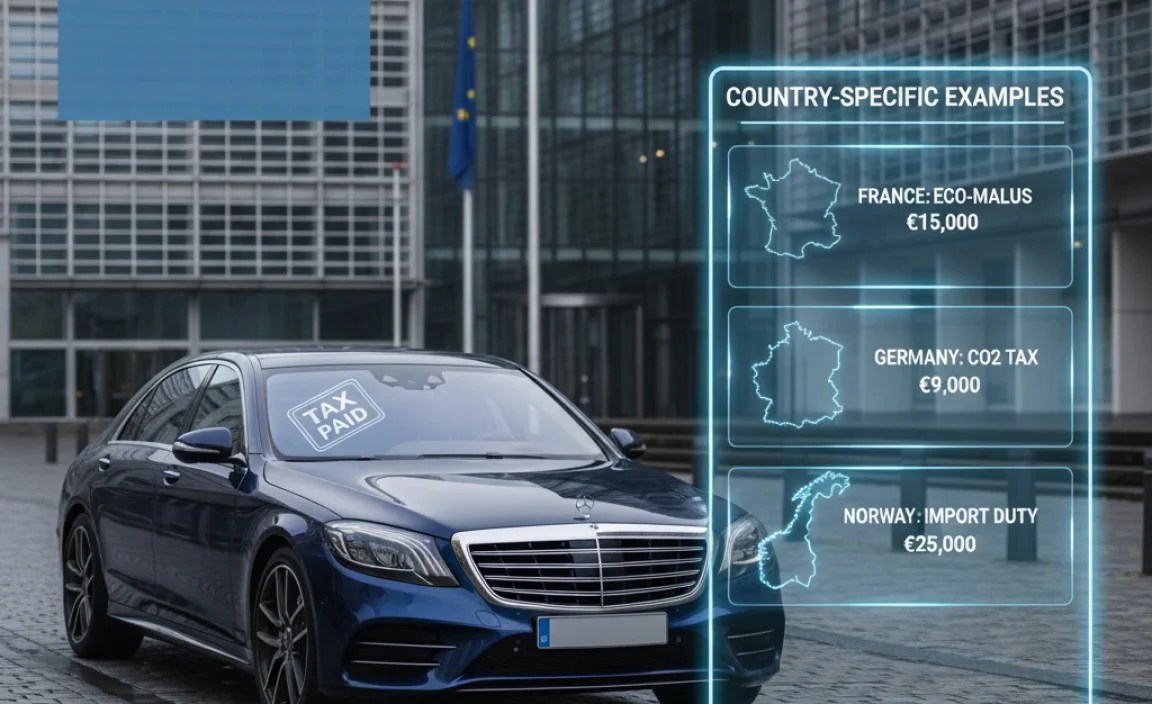
To illustrate the differences in tax systems, let’s look at specific examples from a few European countries.
Germany
In Germany, the main taxes associated with owning a Mercedes sedan are VAT, registration tax (Kraftfahrzeugsteuer), and potentially environmental taxes.
- VAT: The standard VAT rate is 19%.
- Registration Tax (Kraftfahrzeugsteuer): This is based on engine size and CO2 emissions. For gasoline engines, it’s calculated based on the engine displacement in cubic centimeters (cc) and the CO2 emissions in grams per kilometer (g/km). For diesel engines, the tax rates are generally higher.
- Environmental Zones: Many German cities have environmental zones (Umweltzonen) where only vehicles with specific emission stickers (Umweltplakette) are allowed. Vehicles that don’t meet the standards may face fines.
France
In France, owning a Mercedes sedan involves VAT, registration tax (Carte Grise), and an annual tax based on CO2 emissions (Malus écologique).
- VAT: The standard VAT rate is 20%.
- Registration Tax (Carte Grise): This includes several components, including a regional tax based on horsepower and CO2 emissions.
- Malus écologique: This is a tax on vehicles with high CO2 emissions. The tax amount increases with higher emissions levels.
United Kingdom
In the UK, the taxes include VAT and Vehicle Excise Duty (VED), also known as road tax.
- VAT: The standard VAT rate is 20%.
- Vehicle Excise Duty (VED): This is an annual tax based on CO2 emissions. Vehicles with zero emissions are currently exempt.
Italy
In Italy, you’ll encounter VAT, a provincial registration tax, and a possible luxury tax if the vehicle is particularly powerful.
- VAT: The standard VAT rate is 22%.
- Provincial Registration Tax: This varies by region and is based on engine power (kW).
- Luxury Tax (Superbollo): This applies to vehicles with power exceeding a certain threshold (e.g., 185 kW) and is an additional annual tax.
Strategies to Reduce Your Tax Burden

While you can’t eliminate taxes altogether, there are strategies to potentially reduce your tax burden when buying or owning a Mercedes sedan in Europe.
Choose a Fuel-Efficient Model
Opting for a Mercedes sedan with a smaller engine or hybrid/electric powertrain can significantly reduce your taxes. Many countries offer incentives for eco-friendly vehicles.
- Consider Hybrid or Electric Models: These often have lower or zero CO2 emissions, leading to lower registration and road taxes.
- Smaller Engine Options: A smaller engine typically means lower engine size-based taxes.
Take Advantage of Tax Incentives
Many European countries offer tax incentives for environmentally friendly vehicles. Research these incentives before making a purchase.
- Government Subsidies: Some countries offer subsidies for buying electric or hybrid vehicles.
- Tax Exemptions: Electric vehicles are often exempt from road tax and/or registration tax.
Consider Leasing
Leasing a vehicle can sometimes be more tax-efficient than buying, especially for businesses. Consult with a tax advisor to determine if leasing is the right option for you.
Purchase a Used Vehicle
The initial registration tax on a used vehicle may be lower than on a new vehicle. However, consider the potential for higher maintenance costs with older vehicles.
Register the Vehicle in a Lower-Tax Country (If Possible)
If you have residency options in multiple countries, consider registering the vehicle in the country with the lowest taxes. However, be aware of the legal requirements and potential restrictions.
Navigating the Tax System: Step-by-Step Guide

Here’s a step-by-step guide to help you navigate the tax system when buying a Mercedes sedan in Europe:
- Research Tax Laws: Before buying a car, thoroughly research the tax laws in the country where you plan to register the vehicle. Use official government websites and consult with tax professionals.
- Calculate Potential Taxes: Use online tax calculators or consult with a tax advisor to estimate the taxes you’ll need to pay.
- Factor Taxes into Your Budget: Include all potential taxes in your budget to avoid financial surprises.
- Gather Required Documents: Collect all necessary documents for vehicle registration and tax payments.
- Pay Taxes on Time: Ensure you pay all taxes on time to avoid penalties and fines.
- Keep Records: Keep accurate records of all tax payments for future reference.
Resources for Further Information
Here are some useful resources for finding more information about vehicle taxes in Europe:
- European Commission Taxation and Customs Union: This website provides information on VAT rates and other tax-related topics across the EU. https://taxation-customs.ec.europa.eu/index_en
- National Tax Authorities: Each European country has its own tax authority website with detailed information on vehicle taxes.
- Automobile Associations: Automobile associations like the AAA or similar organizations in Europe often provide information on vehicle taxes and regulations.
- Tax Advisors: Consulting with a tax advisor who specializes in international taxation can provide personalized advice tailored to your specific situation.
FAQ: Mercedes Sedan Tax in Europe
1. What is VAT on a Mercedes sedan in Europe?
VAT is a consumption tax added to the price of the car. The rate varies by country, typically between 17% and 27%.
2. How is road tax calculated?
Road tax is usually calculated based on engine size, CO2 emissions, vehicle weight, or a combination of these factors. Some countries are moving towards CO2 emissions-based taxation.
3. Are electric vehicles exempt from taxes in Europe?
Many European countries offer tax exemptions or incentives for electric vehicles, such as exemption from road tax or registration tax. These incentives vary by country.
4. What is registration tax?
Registration tax is a one-time tax paid when you register a vehicle. It’s often based on engine size, power output, CO2 emissions, or the vehicle’s value.
5. How can I reduce my Mercedes sedan tax?
You can reduce your tax burden by choosing a fuel-efficient model, taking advantage of tax incentives for eco-friendly vehicles, considering leasing, or purchasing a used vehicle.
6. What is “Malus écologique” in France?
Malus écologique is a tax on vehicles with high CO2 emissions in France. The tax amount increases with higher emissions levels.
7. Where can I find the most up-to-date information on vehicle taxes?
You can find the most up-to-date information on vehicle taxes on the official websites of national tax authorities in each European country.
Conclusion
Understanding the tax implications of owning a Mercedes-Benz sedan in Europe is crucial for making informed decisions and avoiding unexpected costs. By researching the tax laws in the relevant country, calculating potential taxes, and exploring strategies to reduce your tax burden, you can navigate the system with confidence. Remember to consult official government websites and tax professionals for personalized advice. With the right information, you can enjoy your Mercedes sedan without financial surprises.
“`


