
Mercedes A Class: Ultimate Acceleration Stats
Discover how fast the Mercedes-Benz A-Class is! We break down the acceleration stats for different A-Class models, from the sporty A 200 to the powerful AMG A 45 S, helping you understand what makes this compact luxury car so exhilarating to drive.
The thrill of a powerful engine and swift acceleration is a key part of the Mercedes-Benz driving experience. Many owners and potential buyers are curious about just how quickly their A-Class can get up to speed, especially the performance-oriented variants. It’s a common question that touches on the heart of what makes driving fun: that surge of power when you press the pedal. Whether you’re comparing different trims or simply want to appreciate your car’s capabilities, understanding acceleration stats can enhance your ownership. This guide will demystify the numbers, comparing acceleration times across the Mercedes-Benz A-Class range, so you can confidently know what to expect.
So, let’s dive into the exciting world of A-Class acceleration!
Understanding Acceleration: The 0-60 MPH Metric

When we talk about car acceleration, the most commonly used benchmark is the 0-60 miles per hour (MPH) time. This measurement tells you how many seconds it takes for a vehicle to accelerate from a standstill to 60 MPH. It’s a standardized way to compare the performance of different cars, giving drivers a clear picture of their car’s responsiveness and outright speed.
For a compact luxury car like the Mercedes-Benz A-Class, acceleration is a crucial aspect of its appeal. It signifies not just raw speed but also engine power, transmission tuning, and overall engineering prowess. From the entry-level models offering spirited performance to the fire-breathing AMG versions designed for ultimate exhilaration, the 0-60 MPH time is a key differentiator. We’ll explore these figures for various A-Class models to give you a comprehensive overview.
Mercedes-Benz A-Class Acceleration: Model by Model Breakdown

The Mercedes-Benz A-Class comes in several iterations, each offering a distinct blend of luxury, technology, and performance. The acceleration figures can vary significantly depending on the engine, drivetrain (front-wheel drive or all-wheel drive), and specific trim level. Here’s a look at some popular A-Class models and their typical 0-60 MPH times.
Standard A-Class Models (e.g., A 200, A 220, A 250)
These models often represent the core of the A-Class lineup, focusing on offering a premium compact experience. While not designed for outright track performance, they provide sprightly acceleration suitable for both city driving and highway cruising. Common engine options include turbocharged four-cylinder units, often paired with responsive automatic transmissions.
- A 200: Typically equipped with a 1.3-liter or 1.5-liter turbocharged engine, the A 200 offers a balance of efficiency and performance. Expect 0-60 MPH times to be in the range of 8.0 to 8.5 seconds.
- A 220 / A 250: These trims generally feature a more powerful 2.0-liter turbocharged engine, often with Mercedes-Benz’s 4MATIC all-wheel-drive system as standard or an option. The increased power and grip translate to quicker acceleration, with 0-60 MPH times typically falling between 6.0 and 7.0 seconds.
AMG A 35 4MATIC
Stepping up to the AMG A 35 signifies a significant leap in performance. This model is designed to offer a taste of AMG’s performance engineering in a more accessible package. It boasts a more potent 2.0-liter turbocharged engine, often tuned to produce upwards of 300 horsepower, and comes standard with the 4MATIC all-wheel-drive system.
- AMG A 35 4MATIC: With its enhanced engine and performance-oriented AWD, the AMG A 35 is capable of delivering blistering acceleration. 0-60 MPH times are generally around the 4.7 to 5.0 second mark, making it a genuinely quick compact car.
AMG A 45 S 4MATIC+ (The Ultimate Performance)
For those seeking the pinnacle of performance in the A-Class range, the AMG A 45 S is the undisputed champion. This model is a true homologation special, packing an incredibly powerful handcrafted AMG engine and sophisticated performance technology. It’s designed to compete with the fastest hot hatchbacks and compact performance cars on the market.
- AMG A 45 S 4MATIC+: Equipped with the world’s most powerful series-production four-cylinder engine, the AMG A 45 S delivers mind-blowing acceleration. 0-60 MPH times are exceptional, often quoted as low as 3.9 seconds. This makes it one of the quickest production cars in its class and even rivals some sports cars.
Factors Influencing A-Class Acceleration

While the engine and drivetrain are the primary determinants of acceleration, several other factors play a role in how quickly an A-Class can reach 60 MPH. Understanding these can help explain why you might experience slightly different results than the manufacturer’s quoted figures.
Engine Power and Torque
The most direct influence on acceleration is the engine’s power (measured in horsepower) and torque (measured in pound-feet or Newton-meters). A higher horsepower figure generally means a higher top speed, while torque is more indicative of how quickly the car can accelerate from a standstill and at lower speeds. AMG models, for instance, benefit from significantly higher power and torque outputs.
Drivetrain: Front-Wheel Drive vs. All-Wheel Drive (4MATIC)
Mercedes-Benz’s 4MATIC all-wheel-drive system is crucial for maximizing acceleration, especially in higher-performance models. It distributes power between the front and rear wheels to provide optimal traction. On powerful cars like the AMG A 35 and A 45 S, 4MATIC helps prevent wheel spin from the line, allowing the car to put its power down more effectively and achieve quicker 0-60 MPH times. Front-wheel-drive models may experience more wheel spin from a dig, potentially increasing acceleration times.
Transmission Type and Tuning
The A-Class primarily uses Mercedes-Benz’s advanced automatic transmissions, such as the 7G-DCT (dual-clutch transmission) or the AMG SPEEDSHIFT DCT 8G. Dual-clutch transmissions are designed for lightning-fast gear changes with minimal power interruption, which is critical for achieving rapid acceleration. The transmission’s shift logic and programming also influence how quickly and smoothly the car accelerates through the gears.
Vehicle Weight
A lighter vehicle generally accelerates faster than a heavier one, assuming similar power outputs. The A-Class, being a compact car, generally maintains a relatively manageable weight compared to larger luxury sedans or SUVs. However, specific options like sunroofs, premium sound systems, or the addition of 4MATIC can add a few pounds, subtly affecting acceleration.
Tire Condition and Road Surface
The condition of your tires and the surface you’re accelerating on have a significant impact. Worn tires or a slippery surface (rain, snow, or even just dust) will lead to reduced traction and increased wheel spin, hindering acceleration. Conversely, high-performance tires on a dry, grippy surface will allow the car to transfer power to the road much more efficiently.
Launch Control
Many performance-oriented A-Class models, particularly the AMG variants, feature a “Launch Control” system. This sophisticated electronic aid allows the driver to achieve optimal acceleration from a standstill by pre-setting engine revs and managing traction and gear shifts. When used correctly, it can significantly improve 0-60 MPH times by minimizing driver error and maximizing grip.
Performance Data Comparison Table
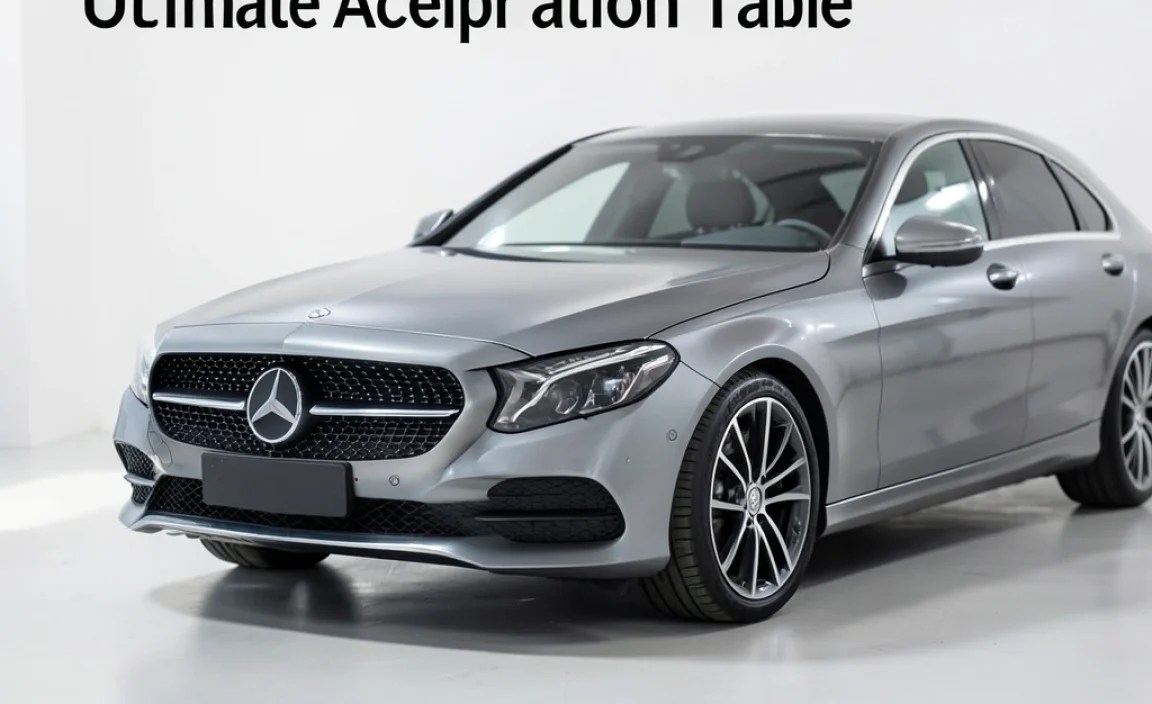
To provide a clear, side-by-side comparison, here’s a table showcasing typical acceleration stats for various Mercedes-Benz A-Class models. Please note that these figures are approximate and can vary based on specific model years, regional specifications, and testing conditions.
| Model | Engine (Typical) | Horsepower (Approx.) | Drivetrain | 0-60 MPH (Seconds, Approx.) |
|---|---|---|---|---|
| A 200 | 1.3L Turbo I4 | 163 HP | FWD | 8.2 |
| A 250 4MATIC | 2.0L Turbo I4 | 221 HP | AWD | 6.1 |
| AMG A 35 4MATIC | 2.0L Turbo I4 | 302 HP | AWD | 4.7 |
| AMG A 45 S 4MATIC+ | 2.0L Turbo I4 (Handcrafted) | 416 HP | AWD | 3.9 |
Note: Specific model years and regional variations may have different specifications and performance figures. Always refer to the official specifications for your particular vehicle.
The AMG Difference: Engineering for Extreme Acceleration

The transformation from a standard A-Class to an AMG A 35 or A 45 S is profound. AMG engineers don’t just tune an engine; they re-engineer the entire vehicle to excel at performance. This involves much more than just increasing horsepower.
- Handcrafted Engines: The heart of the AMG A 45 series is its handcrafted “one man, one engine” philosophy, meaning a single technician assembles the entire engine. This meticulous process ensures the highest quality and allows for tighter tolerances, contributing to the engine’s incredible power density. For more on AMG’s engine building, you can explore the AMG engine assembly process.
- Advanced Turbocharging: AMG employs sophisticated turbocharging technology, including twin-scroll turbochargers and larger intercoolers, to provide immediate throttle response and sustained power delivery, minimizing turbo lag.
- Performance Exhaust Systems: Aggressive exhaust notes are as crucial to the AMG experience as the speed they help achieve. These systems are designed for optimal gas flow, contributing to better performance.
- Optimized Drivetrain and Chassis: To handle the immense power, AMG models feature reinforced transmissions, performance-tuned 4MATIC+ all-wheel-drive systems capable of torque-vectoring (especially on the A 45 S), and a comprehensively retuned suspension and braking system.
- Aerodynamics: AMG body styling isn’t just for looks. Larger air intakes, spoilers, and diffusers are engineered to improve downforce and cooling, which are vital at high speeds and during aggressive driving.
The result is a vehicle that doesn’t just accelerate but launches itself forward with relentless force, offering a driving experience that is both exhilarating and precisely controlled.
Real-World Acceleration: Beyond the Numbers
While the 0-60 MPH statistic is a great indicator, the driving experience is more than just a single number. The way a car feels during acceleration is equally important. Mercedes-Benz, even in its non-AMG models, prioritizes a sense of refinement and confidence.
- Everyday Usability: Standard A-Class models provide brisk acceleration that makes merging onto highways, overtaking slower vehicles, and navigating city traffic effortless. The power delivery is smooth, and the transmission is intelligent, anticipating driver needs.
- Sporty Engagement: For models like the A 250 and AMG A 35, the acceleration offers a more pronounced surge. The engine note becomes more pronounced, and the car feels eager to respond to inputs. Manual shifting via the paddle shifters can transform the driving experience, offering near-instantaneous gear changes.
- Unadulterated Thrill: The AMG A 45 S offers an experience that borders on extreme. The sheer rate of acceleration can be breathtaking, requiring you to brace yourself. The traction from the sophisticated 4MATIC+ system ensures that almost every ounce of that power is translated into forward motion.
It’s important to remember that achieving the optimal acceleration figures often requires specific conditions and, in performance models, the use of features like Launch Control. For regular driving, the A-Class offers a spectrum of performance that caters to comfort, efficiency, or exhilarating speed.
FAQs about Mercedes A-Class Acceleration
Q1: What is the fastest Mercedes-Benz A-Class model in terms of acceleration?
The fastest Mercedes-Benz A-Class model is the AMG A 45 S 4MATIC+, which can accelerate from 0 to 60 MPH in approximately 3.9 seconds. This is due to its powerful 416 horsepower handcrafted engine and advanced all-wheel-drive system.
Q2: Do all A-Class models come with all-wheel drive?
No, not all A-Class models come with all-wheel drive. While higher-performance models like the AMG A 35 and AMG A 45 S have it as standard, many standard A-Class variants, such as the A 200 or A 250 in some markets, are available with front-wheel drive (FWD) or have 4MATIC all-wheel drive as an optional upgrade.
Q3: Does the transmission affect acceleration times?
Yes, the transmission type and tuning significantly affect acceleration times. Mercedes-Benz A-Class models primarily use dual-clutch transmissions (DCTs) like the 7G-DCT or AMG SPEEDSHIFT DCT 8G. These transmissions are designed for very fast and smooth gear changes, minimizing power loss and contributing to quicker 0-60 MPH times compared to traditional torque converter automatics or manual transmissions.
Q4: What is “Launch Control” and how does it improve acceleration?
Launch Control is an electronic system found in many performance vehicles, including AMG A-Class models. It allows the driver to achieve the quickest possible acceleration from a standstill by setting the optimal engine RPM and automatically managing the transmission’s shifts and traction control. This maximizes grip and minimizes wheel spin, leading to faster 0-60 MPH times.
Q5: Are the 0-60 MPH times official Mercedes-Benz figures?
The 0-60 MPH times commonly cited are typically based on manufacturer specifications or independent automotive testing. These figures are generally reliable but can vary slightly due to different testing methodologies, vehicle specifications (optional equipment), tire conditions, and environmental factors. For the most accurate figures for your specific model and year, consult the official Mercedes-Benz specifications.
Q6: Can I improve my A-Class’s acceleration?
For standard models, minor improvements might be achieved through regular maintenance and ensuring tires are in good condition. For significant acceleration gains, you would typically look at aftermarket tuning options, such as ECU remapping or hardware upgrades. However, these modifications can affect warranty and emissions compliance. For official information on performance tuning and modifications, you might explore resources like the U.S. Environmental Protection Agency (EPA) guidelines on vehicle modifications.
Conclusion
The Mercedes-Benz A-Class offers a compelling range of acceleration statistics, catering to a wide spectrum of drivers. From the efficient yet spirited acceleration of the A 200 to the awe-inspiring velocity of the AMG A 45 S, each model provides its unique brand of performance. Understanding the factors that influence these numbers—engine power, drivetrain, transmission, and more—allows for a deeper appreciation of the engineering that goes into every A-Class. Whether you prioritize comfortable cruising, sporty engagement, or outright track-day performance, there’s an A-Class model that delivers precisely the acceleration you desire, wrapped in a package of renowned Mercedes-Benz luxury and innovation.


