
Ultimate Mercedes maintenance intervals by model
Mercedes maintenance intervals by model: Genius Plan
Maintaining your Mercedes-Benz is crucial for its longevity, performance, and resale value. Understanding the specific maintenance intervals for your model, whether it’s a nimble A-Class, a robust GLS, or an electrifying EQE, can seem complex. This guide simplifies everything, providing clear, model-specific insights to help you keep your cherished vehicle running flawlessly and prevent costly issues down the road.
Owning a Mercedes-Benz is an experience synonymous with luxury, performance, and advanced engineering. To truly savor that experience for years to come, adhering to a consistent maintenance schedule is not just recommended—it’s essential. Many owners find themselves puzzled by the Service A and Service B notifications, or wonder how their specific model, be it a dynamic C-Class sedan, a versatile GLC SUV, or a powerful AMG variant, might differ in its upkeep requirements. Rest assured, you’re not alone in seeking clarity on this vital aspect of Mercedes-Benz ownership. This comprehensive guide, crafted by the enthusiasts at MercedesBlue, will demystify your Mercedes-Benz maintenance intervals by model, ensuring you have all the knowledge to protect your investment and enjoy every mile. We’ll break down everything from routine checks to model-specific considerations, helping you navigate your service schedule with confidence.
The Foundation: Understanding Mercedes-Benz ASSYST PLUS

At the heart of Mercedes-Benz’s maintenance system lies ASSYST PLUS, a sophisticated onboard computer that actively monitors your vehicle’s operating conditions, mileage, and time since the last service. Unlike older systems that relied solely on fixed mileage or time, ASSYST PLUS provides dynamic service recommendations tailored to your driving habits and environment. This intelligent system helps optimize service intervals, ensuring that maintenance is performed precisely when needed, not just based on a generic schedule.
When your vehicle is due for service, the ASSYST PLUS system will display a notification on your instrument cluster, typically indicating either “Service A Due” or “Service B Due,” along with a wrench icon. It’s crucial to pay attention to these alerts, as they are your vehicle’s way of communicating its needs. Ignoring these warnings can lead to reduced performance, increased wear on components, and potentially more expensive repairs in the long run. For more information on how these systems contribute to vehicle health, you can explore resources like the National Highway Traffic Safety Administration (NHTSA) for general automotive safety and maintenance importance.
Service A: Your Mercedes-Benz’s First Check-Up

Service A is typically the first major maintenance check-up for most new Mercedes-Benz models, usually recommended at approximately 1 year or 10,000 miles, whichever comes first. This initial service is crucial for setting the foundation for your vehicle’s long-term health. It’s a comprehensive inspection and basic service designed to address the most immediate needs of a new or recently serviced vehicle.
What does Service A usually include?
- Synthetic motor oil replacement
- Oil filter replacement
- Fluid level checks and corrections (brake fluid, power steering fluid, windshield washer fluid, coolant)
- Tire inflation check and correction
- Brake component inspection
- Resetting the maintenance counter
While Service A is often considered the “minor” service, it’s vital. It ensures that the engine’s lubrication is fresh, critical fluids are at optimal levels, and key safety components like brakes and tires are in good order. This early check helps identify any potential issues before they become significant problems, ensuring your Mercedes operates at peak efficiency and safety. Many reputable automotive care guides, such as those from AAA Automotive, emphasize the importance of regular oil changes and basic inspections for vehicle longevity.
Service B: The Comprehensive Review

Service B is a more extensive maintenance package, typically recommended at 2 years or 20,000 miles, and then every 20,000 miles thereafter. This service builds upon the foundation of Service A, delving deeper into your vehicle’s systems to ensure all components are functioning optimally. It’s designed to address wear and tear that accumulates over a longer period or higher mileage.
What does Service B generally include?
- Synthetic motor oil replacement
- Oil filter replacement
- Cabin dust/combination filter replacement
- Brake fluid exchange
- Fluid level checks and corrections
- Tire inflation check and correction
- Brake component inspection
- Resetting the maintenance counter
- Detailed inspection of all accessible components including belts, hoses, suspension, steering, and exhaust system
The addition of a cabin filter replacement and brake fluid exchange in Service B are critical. The cabin filter ensures clean air quality inside your vehicle, while fresh brake fluid is essential for maintaining optimal braking performance and preventing corrosion within the brake lines. Regular brake fluid exchanges are a key safety measure often highlighted by automotive experts. Service B provides a thorough health check for your Mercedes-Benz, ensuring its advanced systems continue to perform flawlessly.
Typical Maintenance Schedule Overview
Here’s a simplified look at the alternating nature of Service A and Service B:
- **1 Year / 10,000 Miles:** Service A
- **2 Years / 20,000 Miles:** Service B
- **3 Years / 30,000 Miles:** Service A
- **4 Years / 40,000 Miles:** Service B
- …and so on.
Remember, these are general guidelines. Your vehicle’s ASSYST PLUS system is the ultimate authority for your specific service needs.
Model-Specific Maintenance Nuances
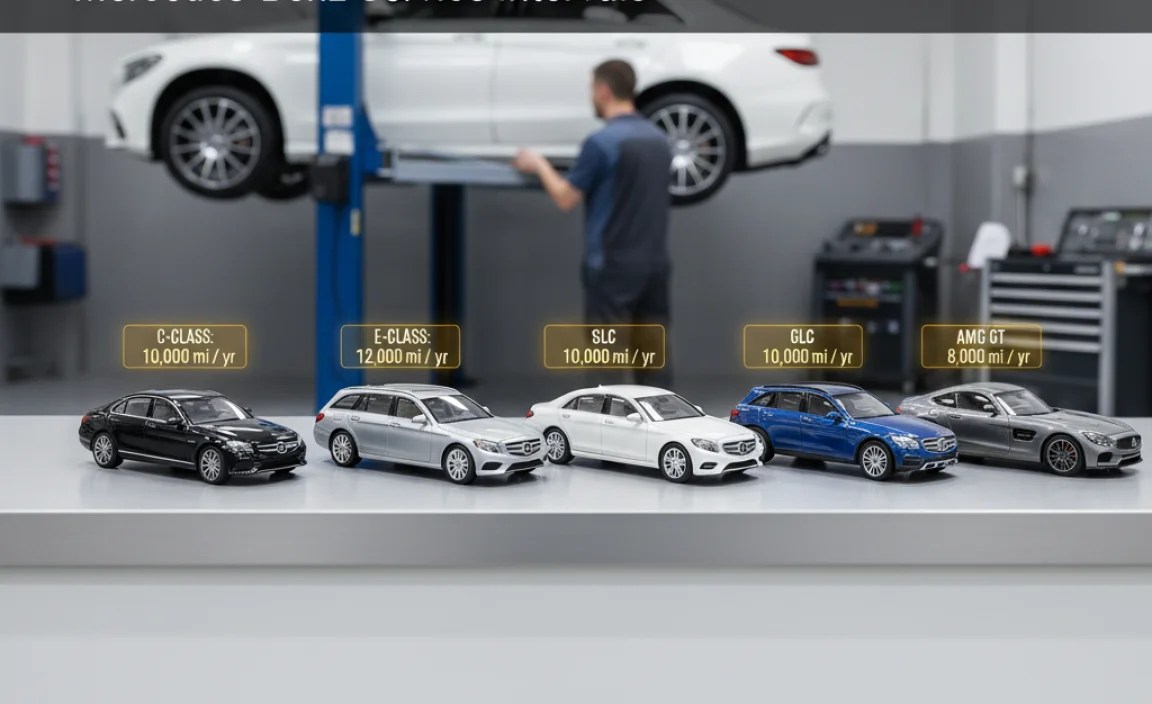
While Service A and B form the core of Mercedes-Benz maintenance, specific models and powertrains introduce unique considerations. The sophisticated engineering behind each Mercedes-Benz model means that while many service items are universal, others are tailored to the vehicle’s design and performance characteristics.
Sedans (A-Class, C-Class, E-Class, S-Class, CLA, CLS)
Mercedes-Benz sedans are celebrated for their blend of luxury, comfort, and dynamic driving. Maintenance for these models generally follows the Service A/B schedule. However, depending on the engine (e.g., 4-cylinder, V6, V8) and transmission, additional items may be recommended:
- **Spark Plug Replacement:** Typically every 30,000-50,000 miles, though this can vary. Higher-performance engines might have different intervals.
- **Transmission Fluid & Filter Service:** Many Mercedes-Benz automatic transmissions (especially 7G-TRONIC and 9G-TRONIC) recommend a fluid and filter change between 60,000 and 80,000 miles. This is a critical service for transmission longevity.
- **Air Filter Replacement:** Engine air filters are typically replaced every 20,000-40,000 miles, depending on driving conditions.
SUVs & Crossovers (GLA, GLB, GLC, GLE, GLS, G-Class)
SUVs and Crossovers often face varied driving conditions, from urban commutes to light off-roading, and may carry heavier loads. While their core Service A/B schedule remains similar to sedans, a few points deserve extra attention:
- **Brake Wear:** Due to their size and weight, SUV brakes might experience more wear, especially if frequently driven in stop-and-go traffic or with heavy loads. Regular brake inspections are paramount.
- **All-Wheel Drive (4MATIC) System Checks:** For 4MATIC models, differential fluid checks and changes might be recommended at higher mileages (e.g., 60,000-100,000 miles) to ensure the optimal functioning of the all-wheel-drive system.
- **Tire Rotations and Alignment:** Given the larger tire sizes and potential for more varied driving, frequent tire rotations (every 5,000-7,500 miles) and alignment checks are crucial to ensure even tire wear and stability.
AMG Performance Models (A 45 AMG, C 63 AMG, G 63 AMG, AMG GT)
AMG vehicles are engineered for exhilarating performance, and their maintenance schedules reflect this intensity. While they still adhere to the Service A/B framework, there are crucial enhancements:
- **More Frequent Oil Changes:** Drivers who frequently push their AMG vehicles might benefit from more frequent oil changes than the standard 10,000-mile interval.
- **High-Performance Brake System Checks:** AMG brakes are immensely powerful but also subject to higher wear. Regular, thorough inspections of pads, rotors, and fluid are non-negotiable.
- **Transmission Fluid Service:** Due to the higher stresses placed on the transmission, fluid and filter changes might be recommended at slightly more frequent intervals than standard models.
- **Spark Plugs:** High-output engines often require spark plug replacement at shorter intervals.
- **Differential Fluid:** Performance differentials, especially in models like the C 63 or AMG GT, may have specific fluid change requirements.
Electric Models (EQA, EQB, EQC, EQE, EQS, EQV)
The all-electric EQ range represents the future of Mercedes-Benz, and their maintenance needs differ significantly from internal combustion engine (ICE) vehicles. While they still require regular servicing, the focus shifts:
- **Fewer Traditional Fluid Changes:** No engine oil, spark plugs, or fuel filters to replace.
- **Brake System Emphasis:** Regenerative braking reduces wear on physical brake components, but they still require regular inspection and brake fluid changes (part of Service B).
- **Coolant for Battery & Motor:** Electric vehicles have cooling systems for their battery packs and electric motors. These coolants need checking and occasional replacement.
- **Tire Wear:** Due to the instant torque and heavier battery packs, tire wear can sometimes be more pronounced. Regular rotations and alignment checks are vital.
- **Cabin Air Filters:** These remain essential for air quality.
- **Software Updates:** Often performed during service visits to optimize performance and features.
For more detailed insights into electric vehicle maintenance, resources like the U.S. Department of Energy’s EV information can provide a broader understanding of how these vehicles differ in their upkeep requirements.
Older Models (GLK-Class, SLK-Class, M-Class, R-Class)
For Mercedes-Benz models from previous generations, while the Service A/B structure still applies, some specific considerations arise:
- **Fluid Specifications:** Ensure that the correct fluid types (oil, coolant, transmission fluid) are used, as specifications can evolve over time.
- **Common Wear Items:** Older vehicles might require more frequent checks or replacements of items like belts, hoses, suspension components, and bushings.
- **Corrosion Checks:** Especially in regions with harsh winters, regular checks for rust or corrosion on the undercarriage and brake lines are important.
- **Software Updates:** While less frequent than newer models, ensure any available software updates have been applied.
Beyond A & B: Key Maintenance Milestones

While Service A and B cover the recurring essentials, your Mercedes-Benz also has specific components that require attention at longer intervals. These are often mileage-dependent but also influenced by time.
| Maintenance Item | Typical Interval (Approx.) | Importance |
|---|---|---|
| **Brake Fluid Exchange** | Every 2 years / 20,000 miles (part of Service B) | Prevents moisture contamination, maintains braking efficiency and safety. |
| **Cabin Air Filter Replacement** | Every 2 years / 20,000 miles (part of Service B) | Ensures clean interior air quality and proper HVAC function. |
| **Engine Air Filter Replacement** | Every 20,000 – 40,000 miles (model dependent) | Crucial for engine performance, fuel efficiency, and longevity. |
| **Spark Plug Replacement** | Every 30,000 – 50,000 miles (engine dependent) | Ensures efficient combustion, optimal engine performance, and fuel economy. |
| **Transmission Fluid & Filter Service** | Every 60,000 – 80,000 miles (model/transmission dependent) | Maintains smooth shifting, prevents premature wear, extends transmission life. |
| **Coolant Flush/Exchange** | Every 5 years / 50,000 miles (or as per ASSYST PLUS) | Prevents engine overheating, corrosion, and maintains cooling system efficiency. |
| **Differential Fluid Service (4MATIC)** | Every 60,000 – 100,000 miles (if applicable) | Ensures proper lubrication and function of the all-wheel-drive system. |
| **Fuel Filter Replacement** | Every 60,000 – 80,000 miles (for ICE models, if separate filter) | Protects fuel injectors and engine from contaminants, maintains fuel flow. |
| **Accessory Belt Inspection/Replacement** | Inspect every service, replace as needed (e.g., 60,000-100,000 miles) | Powers accessories like alternator, power steering, A/C compressor. Preventative replacement avoids breakdown. |
These intervals are general guidelines. Always consult your owner’s manual or your Mercedes-Benz service advisor for the precise schedule for your specific VIN, as intervals can vary by model, engine, and even production year.
Factors Influencing Your Maintenance Schedule
While Mercedes-Benz provides meticulous maintenance guidelines, several factors can influence how frequently your specific vehicle needs attention:
- **Driving Habits:** Aggressive driving, frequent short trips, or heavy towing can accelerate wear and tear, potentially requiring more frequent oil changes or brake inspections.
- **Environmental Conditions:** Driving in extreme heat, cold, dusty conditions, or areas with heavy road salt can impact various components, from filters to undercarriage parts.
- **Mileage vs. Time:** Even if you don’t drive much, fluids degrade over time. The “whichever comes first” rule for mileage or time is critical to follow.
- **Vehicle Age:** As a vehicle ages, certain components naturally show more wear. Older models might require more frequent inspections for things like hoses, belts, and suspension components.
The Importance of Genuine Parts and Expert Service
When it comes to maintaining a precision-engineered vehicle like a Mercedes-Benz, the choice of parts and service provider truly matters. Opting for Genuine Mercedes-Benz Parts ensures that every component fits perfectly and meets the manufacturer’s stringent quality and performance standards. These parts are designed to work harmoniously with your vehicle’s complex systems, guaranteeing optimal performance and reliability.
Similarly, choosing a certified Mercedes-Benz technician or a reputable independent specialist with extensive experience in Mercedes-Benz vehicles is paramount. These professionals have access to specialized diagnostic tools, up-to-date technical information, and the expertise required to accurately diagnose and repair your vehicle. Their training ensures that your Mercedes-Benz receives the precise care it needs, safeguarding its advanced technology and preserving its value. Think of it as specialized medical care for a highly sophisticated machine – you wouldn’t trust just anyone with your health, and the same principle applies to your Mercedes-Benz.
DIY vs. Professional Service: What You Can Do
While complex services are best left to professionals, there are several basic checks and tasks you can perform at home to complement your regular maintenance schedule and stay proactive about your Mercedes-Benz’s health:
- **Checking Fluid Levels:** Regularly check your engine oil, coolant, brake fluid, and windshield washer fluid. Ensure they are within the recommended range.
- **Tire Pressure and Tread Depth:** Maintain correct tire pressure for safety and fuel efficiency. Periodically check tread depth to ensure adequate grip.
- **Wiper Blade Replacement:** Worn wiper blades compromise visibility. Replacing them is a simple and effective DIY task.
- **Exterior and Interior Cleaning:** Regular cleaning protects your vehicle’s finish and preserves the luxurious interior.
- **Light Bulb Checks:** Ensure all exterior lights (headlights, taillights, turn signals) are functioning correctly.
For any tasks beyond these basics, especially those involving fluid changes, brake systems, or electronic diagnostics, professional service is highly recommended. Attempting complex repairs without the proper tools, knowledge, and genuine parts can lead to costly damage or compromise safety.
Long-Term Benefits of Adhering to Maintenance Schedules
Consistent, proper maintenance of your Mercedes-Benz offers a multitude of benefits that extend far beyond simply keeping the car running. It’s an investment in the overall health and future value of your vehicle.
- **Enhanced Safety:** Regular checks of brakes, tires, fluids, and safety systems ensure your Mercedes-Benz is always ready to perform safely under various conditions.
- **Optimal Performance:** Fresh fluids, clean filters, and properly functioning components ensure your engine and transmission deliver the performance and driving dynamics you expect from a Mercedes-Benz.
- **Improved Fuel Efficiency:** A well-maintained engine runs more efficiently, translating into better fuel economy and lower operating costs.
- **Extended Vehicle Lifespan:** Proactive maintenance prevents minor issues from escalating into major, expensive problems, significantly extending the life of your vehicle.
- **Higher Resale Value:** A meticulously maintained vehicle with a complete service history is far more attractive to potential buyers, commanding a higher resale value.
- **Reliability and Peace of Mind:** Knowing your Mercedes-Benz is in top condition provides unmatched reliability and peace of mind on every journey.
Frequently Asked Questions About Mercedes-Benz Maintenance
Q1: What’s the main difference between Service A and Service B?
A: Service A is a basic check-up, typically including an oil change, filter replacement, and fluid checks. Service B is more comprehensive, adding a cabin air filter replacement, brake fluid exchange, and a more thorough vehicle inspection to the Service A items. They alternate every 10,000 miles or 1 year.
Q2: How often should I get my oil changed in my Mercedes-Benz?
A: For most modern Mercedes-Benz models, the recommended interval for synthetic motor oil replacement is every 10,000 miles or once a year, whichever comes first, as part of Service A or B. However, your car’s ASSYST PLUS system will give you the precise recommendation based on your driving conditions.
Q3: Do electric Mercedes-Benz (EQ models) require less maintenance?
A: Yes, generally. EQ models eliminate the need for engine oil changes, spark plug replacements, and fuel filter changes. However, they still require regular service for brake fluid, cabin air filters, tire rotations, and inspections of the battery cooling system and other electric powertrain components.
Q4: Why is a brake fluid exchange important, and how often is it needed?
A: Brake fluid is hygroscopic, meaning it absorbs moisture over time. This moisture can reduce the fluid’s boiling point, leading to “brake fade,” and cause corrosion in the brake system. Mercedes-Benz typically recommends a brake fluid exchange every two years or 20,000 miles, as part of Service B, to ensure optimal braking performance and safety.
Q5: Can I perform my own maintenance on my Mercedes-Benz?
A: While basic tasks like checking fluid levels, tire pressure, and replacing wiper blades can be done at home, complex maintenance such as oil changes, brake services, or diagnostic checks require specialized tools, knowledge, and access to genuine Mercedes-Benz parts. For these, it’s highly recommended to visit a certified Mercedes-Benz technician or a reputable specialist.
Q6: Will using non-genuine parts void my warranty?
A: Using aftermarket parts generally won’t void your warranty unless the failure is directly attributable to the non-genuine part. However, Mercedes-Benz strongly recommends using Genuine Mercedes-Benz Parts to ensure compatibility, quality, and optimal performance, thereby maintaining the integrity of your vehicle’s systems.
Q7: What is the ASSYST PLUS system, and how do I know when my service is due?
A: ASSYST PLUS is your Mercedes-Benz’s onboard service reminder system. It dynamically calculates when your next service is due based on mileage, time, and driving conditions. Your vehicle’s instrument cluster will display a “Service A Due” or “Service B Due” message, often accompanied by a wrench icon, when maintenance is required.
Conclusion
Understanding and adhering to the maintenance intervals for your Mercedes-Benz, whether it’s a sophisticated sedan, a robust SUV, a thrilling AMG, or an innovative EQ electric vehicle, is the bedrock of responsible ownership. By paying attention to your ASSYST PLUS system, following the rhythm of Service A and Service B, and being aware of your specific model’s unique needs, you’re not just performing routine tasks—you’re investing in the enduring performance, safety, and luxury that define the Mercedes-Benz experience. Remember, consistent care from qualified professionals using genuine parts is the best way to ensure your vehicle continues to deliver the unparalleled driving pleasure and reliability you expect. Drive confidently, knowing your Mercedes-Benz is meticulously maintained for every journey ahead.


